
Dental Implants
Don’t let tooth loss affect your health and quality of life!
What are Dental Implants?
A dental implants replaces the tooth root and builds a solid foundation for crowns, bridges or an overdenture. Dental implants are the only dental prosthetics available today that will actually stop the bone loss that continues to happen once a tooth is lost. A dental bridge is anchored to neighbouring teeth that need to be ground down to allow for the fabrication of a crown. A bridge ties 3 or more teeth together meaning that when you develop decay under one of the crowns, the entire bridge has to be cut off and replaced.
A dental implant can replace a single tooth without damaging or affecting the neighbouring teeth.
Benefits of dental implants:
-
A natural looking smile
-
Normal eating and speaking
-
Neighbouring teeth stay intact
-
Stable and comfortable fit
-
A long-lasting and proven solution to tooth loss
Why consider Dental Implants?
-
Social
Missing or damaged teeth can make you feel less confident to smile or laugh. You might choose to avoid contact with other people which can lead to depression and loneliness.
-
Nutrition
Eating hard, crunchy or sticky foods can become very difficult and you may even find yourself frequently eating the same foods which can have negative effects on your overall health. Chewing food properly can be a challenge and many denture wearers end up swallowing large bolus of food that is difficult for your stomach and intestines to break down and digest properly.
-
Appearance
If you are missing a lot of teeth, your jaw bone starts to shrink. Your lips and cheeks will no longer be supported by your teeth and jaw bone which can make your cheeks look hollow and will make your face look a lot older than it should.
What Is The Process For Dental Implants?
The implant process can take 9-12 months. After a tooth is removed, we like to wait approximately 3 months to allow the tooth socket to heal before evaluating the site for an implant. If there is sufficient bone, an implant can be placed. We need to give the jaw bone 3-9 months to fuse with the implant. Then we can take our records for the fabrication of the implant crown. If there is not enough bone at the missing tooth site after 3 months of healing, a bone grafting procedure will be necessary prior to implant placement.
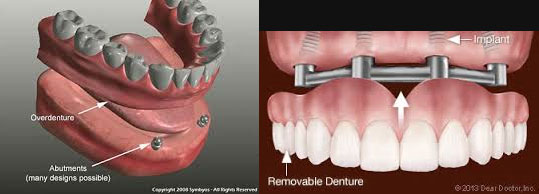
For a patient missing all of their teeth, implant-retained overdentures has been proven to be a very viable and cost-effective treatment alternative with a success rate of 95%-100%. These dentures improve speech, esthetics, function and self-esteem as the dentures will no longer slip and have minimal movement which will minimize soreness, discomfort, and food restrictions.
Treatment options for missing teeth
Dentures, bridge, implants.
Conventional dentures will always move and will not prevent continued bone loss at the site of the missing tooth/teeth.
Patient motivation to maintain great oral hygiene is one of the most important factors for the success of removable partial dentures. As such, dentures have historically had a bad reputation for causing tooth loss when in fact, tooth decay and eventual loss is due to lack of good oral hygiene at home and is completely preventable
Implant Supported Overdentures
For a patient missing all of their teeth, implant-retained overdentures has been proven to be a very viable and cost-effective treatment alternative with a success rate of 95%-100%. These dentures improve speech, esthetics, function and self-esteem as the dentures will no longer slip and have minimal movement which will minimize soreness, discomfort, and food restrictions.


How Much Do Dental Implants Cost?
-
Does the patient need a Bone Graft or Sinus Lift?
-
Do we need to modify the teeth to make room for the implant crown?
-
Does the patient want to whiten first? Depending on the Lab, they may charge different fees.
-
What material are we using?
-
Does the surgeon require a surgical guide?
